But seeing how it's actually an important event and one that doesn't come around too often, I thought I should blog about it.
First, I should say that all Australians over the age of 18 are required by law to vote. I'm not sure how I feel about that. Jeremy tells me that the root of the law was based on the notion that the government wanted a force to equal out the royalists (those favoring the monarchy) which were very vocal in Australia's early days. And so, by forcing Australians to vote, they forced the people to build the country. Makes sense, but it's kinda of a misnomer to force people to exercise their rights, and isn't the ultimate show of democracy the right to choose not to partake in it?
Anyway, that's not the point of this post. The point of this post is that Australia is at a cross road. On June 24th, former Labour Prime Minister Kevin Rudd was overthrown by his Deputy Prime Minister (ie. Vice President) Julia Gillard and the Labour Party in the face of unfavorable polls. It happened because the Australian parliamentary government works like this: Australians vote for a party and the party appoints a leader (in this case, the leader was Kevin Rudd). However, if that leader loses favor with the public and starts dropping in the polls, their party can (and often does) oust them with a vote to elect a new leader.
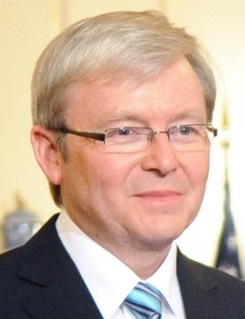
PM Kevin Rudd was elected with one of the highest approval ratings of any Australian Prime Minister, riding in and making some much needed changes. Upon election in 2007, K-Rudd (or KRudd -- both loving nicknames) ratified the Kyoto Protocol and made a public apology to the Stolen Generations (Aboriginals and Torres Strait Islanders removed from their homes in the mid-90s by the government and the church in an effort to "remove the black in them"). These were immensely popular moves that catapulted Rudd into the stratosphere of popularity. Not only that, but he held the country together during the GFC and is fluent in Chinese (making international relations with their big neighbor better).
But following the International Summit on Climate Change and in light of the international community's reluctance to adopt any serious stance on the environment, Kevin Rudd dropped his policy on carbon trading and refocused on taxing the coal mining industry in Australia (which btw, is one of Australia's biggest exports). The original proposal was for a 40% tax increase on profits called "The Super-Profits Tax." As you can imagine, some mining companies were unhappy about this and the Liberal coalition (Liberal Party + National Party) started towing the line that this tax would drive out businesses and cost Australian's jobs, ultimately ruining the economy. The tax proved too much for Kevin Rudd's popularity and so, with two and a half years as Prime Minister, his party voted him out and his Deputy in out of fear that an unpopular PM would cost them the general election should one be called. (Given that an election must be called once every three years (and Rudd was at two and a half) the election was looming and pressure was rising.)
Talk of Julia Gillard taking over circulated for about a week before it happened though she assured everyone that it was just talk and that she fully supported Kevin Rudd. So it was a bit of a shock when word got out late in the afternoon June 23rd that she was going to challenge him, and even more of a shock when he announced early the next morning that he had resigned and that Julia Gillard was the new Prime Minister, voted in unanimously by his party in the wee hours of the morning.

It's not the first time this has happened (other Prime Ministers include Bob Hawke by Paul Keating while the practice of ousting the leader happens frequently on the Premier level (akin to State Governor) and among the opposition party (ie. whichever party isn't in power)). But people have been upset that Julia Gillard would oust him so quickly and with so much support, despite their growing discontent with his policies. So, with just a few weeks under her belt, Julia Gillard called an election for August 21st to justify her rise to power and hopefully right some wrongs and placate a few dissidents by resolving outstanding issues.
But it's been a hard slog (as the Aussies would say) because even though Ms. Gillard was relatively popular as a Deputy Prime Minister, she's up against a formidable foe: the Liberal Party leader, Tony Abbott.
Now, when I say "formidable", I mean "outspoken", "blokey" and "equally conservative as she is liberal". (Side note: even though they are called the Liberal Party, they are actually conservative ala Republican Style. They are also Royalists (loyal to the Queen) which is decidedly a conservative platform).
About the Candidates
Prime Minister Julia Gillard is surprisingly a single, Athiest woman (oh God, she'd never make it in American politics!) who is in a long-term De-Facto (Common Law Marriage) relationship with a hairdresser. And she doesn't plan on getting married. She was born in Wales (also a no-go for American presidential-hopefuls). She used to be a lawyer for Slater & Gordon (a very large top-tier firm specializing in tort law).
Tony Abbott is a married man with two or three daughters. He's well known for his athleticism, having recently competed in several big races (including an 100km "ultrathon"), and can usually be found in his Speedo on Bondi Beach talking up voters. (But we must give credit where credit is due--he pulls off a speedo well.) Born in London, he originally intended to enter the Catholic priesthood but gave it up for politics, earning himself the title "The Mad Monk."
The Battle
Since Gillard came to office, she has ended the mining tax fiasco by agreeing with the mining companies on a 30% tax increase though it continues to be the leading complaint of the Liberals, primarily because a couple companies have renegaded on the deal and because she has proposed a civilian council/summit to hear people's opinions on the tax. This is one thing that I really don't get--to me, getting civilian opinions and feedback on this sort of issue seems like a really good idea (maybe it's an American thing?), but most Australians are just all out of sorts over it and some quite frankly pissed off. They believe the government is elected and should just make decisions as they see fit and not bother them, the lowly, uneducated people with complicated matters like this. What?!? I just don't get it. I really don't. They are mad but they don't want anyone to listen to them... It's confusing.
Other rather unpopular Labour policies include a website called My School (aimed at creating transparency of school and student performance to parents and the general public), a home insulation program (which resulted in a few home fires due to poorly trained contractors), and a school building scheme (which resulted in mismanaged funds when contractors inflated their costs). One big and personally concerning policy of Labour is the proposal of a nationwide internet filter to weed out things like child pornography (good), but a Wikileaks report showed that the proposed blacklist of the filter also included activist and political groups (not good). While I think it's universally agreed that ridding the internet of heinous crap like child porn is an overwhelming good thing, there is just too much potential for such a web filtering program to be abused on a national scale. Plus, trials and tests have shown the filter is easy to get around.But the trade is that they'll improve Australia's internet connectivity (like 100 fold).
Unpopular Liberal policies include an increase on grocery taxes, increases on power rates, hospital funding cuts, no faith in climate change (planting trees and reducing carbon pollution by 5% isn't enough methinks), they really aren't keen on immigration (maybe that's why it's taking so long for my visa to be approved?), and they are not serious about improving Australia's internet (they see laying fiber optics as a private industrial responsibility which means it won't happen and so all internet connections are running on old copper telephone cables ran by a monopoly--Telstra).
My Personal Opinion
Neither politicians are spectacular. Julia Gillard impressed me once upon a time as an eloquent woman, well spoken on her views and policies but she's been drug into the political mud-slinging rat race. She's lost her dazzle (kinda like Obama, I'm sorry to admit). Tony Abbott is shmarmy and reminds me more of a used car salesman than politician (though I guess they're not that different really). You just know this guy has a lot full of lemons he'd love to show you. And I really dislike the tone he takes and the distrust he exudes when it comes to asylum seekers which he loves calling "Boat People" (it's like calling a Mexican a Beaner--it's rude). I hate that neither side is taking the climate seriously which is in peril.
I can't vote in this election because I'm not a citizen, but if I were, I'd vote Labour--or better, Green Party (it's getting late so I won't explain them--they won't win anyway). Why? Because I believe in health care, gay marriage, I'm pro-immigration (obviously), and climate is high on my list. Jeremy feels the same.
This election is important because the next administration will have to tackle some pretty big issues: climate, mining, the GFC, IT development, housing costs (which are out of this world), and capping Australia's population. I just wish that the two big choices here were more competent people. Lots of Australians have expressed to me that they don't like either choice, so it may mean a lot more go Green, and if they do, we may see a Bush-Gore re-run where the Greens steal some of the Labour vote and the Liberals (conservatives) win. We'll find out tomorrow! Stay tuned!

No comments:
Post a Comment